
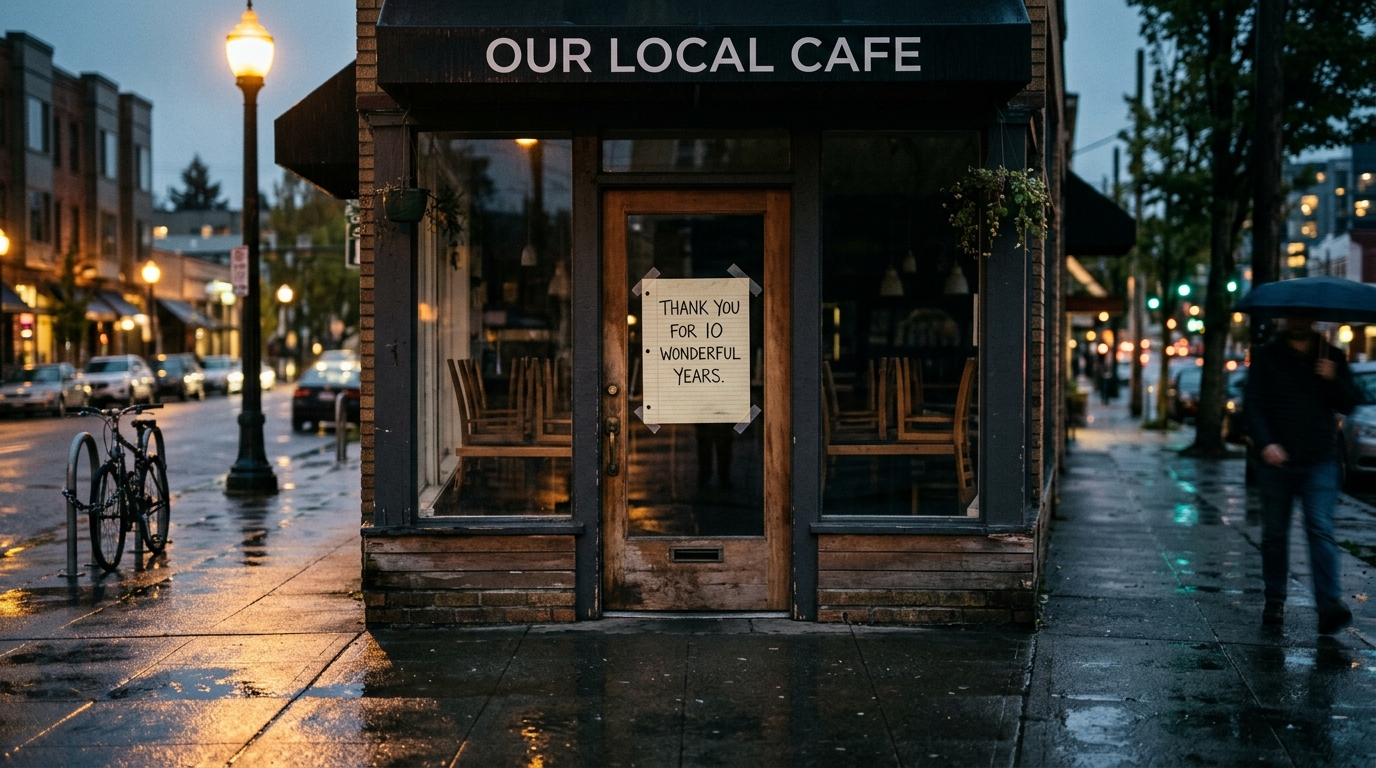
You know the sign. Printer paper, painter’s tape, a Sharpie that was clearly running low. “Thank you for ten wonderful years.” You read it, feel a pang, and think: I meant to go back there. So did a lot of people. That’s sort of the problem.
Independent restaurants rarely close because nobody liked them. They close because people liked them occasionally. This post covers why that keeps happening, why regulars matter more than one-time fans, and how to be a regular without changing your whole life.
Why independent restaurants are closing right now
There’s rarely one villain. Small restaurants usually get worn down by a bunch of pressures landing at once:
- Costs went up and stayed up. Ingredients, rent, insurance, utilities and wages have all climbed in recent years.
- Margins were thin to begin with. A commonly cited industry rule of thumb puts a typical full-service restaurant’s profit at a few cents per dollar of sales. Treat that as a rough estimate. It varies widely, but it means one slow month can wipe out a good quarter.
- Leases come up for renewal. A lot of “sudden” closures are a lease renewal at a number that doesn’t work anymore.
- Habits changed. More delivery, more working from home, fewer casual weekday lunches. Foot traffic that used to be automatic now has to be earned.
- Price sensitivity. When diners feel stretched, eating out is one of the first things to go, and the cheap chain down the street is very good at advertising.
None of that is a secret. What’s easier to miss is how much the line between “struggling” and “fine” comes down to predictable, repeat business.
Why a regular is worth more than a rave review
A five-star review is nice. A person who shows up every other Thursday is a business plan.
Regulars make a restaurant predictable, and predictable is what small operators need most. When a kitchen knows roughly how many people are coming, it orders the right amount of food and throws less away. It can schedule staff without guessing, and it can keep the lights on through a rainy February. Regulars also do marketing nobody can buy: they bring coworkers, visiting parents, and the friend who “doesn’t really like noodles” until they do.
Here’s some napkin math. It’s an illustration, not data. If a small spot has 200 people who each come in twice a month instead of once, that’s 200 extra visits a month without a single dollar spent on ads. Whether that’s the difference between staying open and closing depends on the restaurant. The direction of the effect doesn’t.
Restaurants don’t usually close from a lack of fans. They close from a lack of Tuesdays.
Practical ways to support local spots
None of this requires a budget overhaul or a personality transplant. Pick two or three:
- Pick a rotation. Choose three or four neighborhood places and work through them on purpose. Same total spending, far more impact than scattering it.
- Go on the slow days. Friday nights take care of themselves. Monday through Wednesday is where a regular really counts.
- Order direct when you can. Third-party apps are convenient, but they take a cut. If a restaurant has its own online ordering or takes pickup orders by phone, more of your money stays with the people cooking.
- Buy gift cards as gifts. It’s cash flow for the restaurant now and an easy present for you. Birthdays, thank-yous, the coworker whose name you’re 80% sure of.
- Leave a specific review. “Great food” helps a little. “Get the house special, and they’re fast at lunch” actually helps the next person decide.
- Bring someone new. Recruiting one friend into your rotation roughly doubles your impact, and they owe you one.
- Say something when it’s good. Owners and staff hear complaints all day. “This was great, we’ll be back” carries more weight than you’d think.
One more: if a place you love seems quiet, don’t assume someone else is handling it. That assumption is how the sign ends up on the door.
What it looks like from behind the counter
We run a small aburasoba shop on Brooklyn Ave NE in the U District, so this isn’t abstract for us. The customers who keep a place like ours going aren’t the once-a-year visitors. They’re the student who orders the same bowl every week during finals. They’re the grad who comes back when they’re in town, and the coworkers who make it their Wednesday lunch. We notice them, we’re grateful for them, and frankly they keep us honest.
That goes for the whole neighborhood: the coffee shop, the bakery, the place with the questionable sign and the best dumplings around. A food scene with character is just small businesses with enough regulars to survive a slow season.
The short version
You don’t have to eat out more. Just be a little more deliberate about where you already go. Pick your spots, show up on the boring days, order direct, and tell people. Being a regular is the cheapest and most effective way to keep your neighborhood tasting like your neighborhood.
And the next time you think “I should go back there,” go this week, before the sign goes up.
Back to Blog