
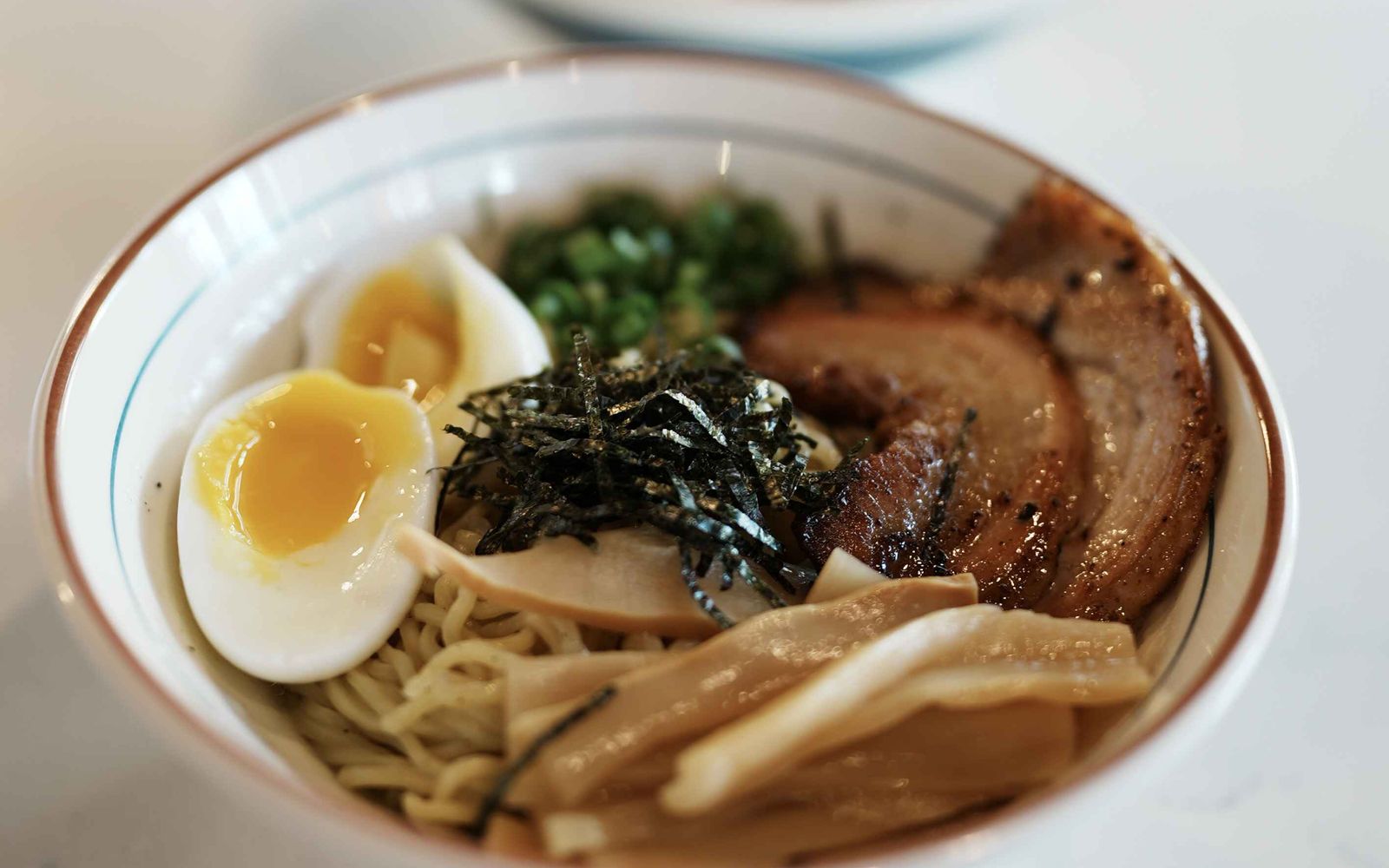
Seattle in November is damp and dark by dinner, and your brain starts asking for food that is rich, salty and shiny. Not a salad. Something with gloss on it.
Aburasoba (油そば, literally “oil noodles”) is built for that craving. There’s no broth: a small amount of concentrated tare and fat sits at the bottom of the bowl, hot noodles go on top, and you mix it all together. A few spoonfuls of sauce end up coating the whole bowl. Here’s how. (If you want the basics first, start with our aburasoba vs. ramen explainer or the history in why everyone is eating ramen without the broth. This one is just the science.)
Broth vs. coating: two ways to deliver flavor
In soup ramen, flavor is spread through a big volume of broth, and every slurp brings some of it along: warm, layered and diluted on purpose.
Aburasoba flips the ratio: instead of a lot of liquid around the noodle, you get a thin, concentrated film on it. So how do you get oil and watery soy sauce to stay on a wet noodle instead of pooling at the bottom? Three things do most of the work: the noodle’s starchy surface, an emulsion, and the way fat carries aroma.
The noodle surface: starch is the glue
Boiling makes the starch on a wheat noodle’s surface swell and partly leak out, leaving it slightly sticky. Italian cooks use the same effect with pasta water. As Serious Eats puts it, starchy pasta water helps a sauce “cling to the pasta better and emulsify with the fat.”
Ramen-style noodles add one more trick. They’re traditionally made with kansui, an alkaline salt solution. A 2014 study in the Journal of Cereal Science (Rombouts and colleagues, “The impact of salt and alkali on gluten polymerization and quality of fresh wheat noodles”) found kansui increases cross-linking in the gluten network. In plain terms: firmer, springier noodles. Ours are made with kansui too. A thick, chewy noodle holds up to vigorous mixing, which is why aburasoba usually skips thin, delicate ones, and why our Tokyo Ganso uses thick noodles (and is super tasty).
The toss: a quick, messy emulsion
Oil and soy sauce don’t mix on their own; left alone, the fat floats on top. In an aburasoba bowl you’re making something closer to a quick pan sauce, tossing hot noodles, watery tare, fat and the moisture and starch the noodles bring with them. That agitation breaks the fat into small droplets, and dissolved starch helps keep them suspended. The result is a cloudy, glossy coating instead of two separate layers.
Physicists have actually tested this with pasta. In 2025, a team of Italian researchers published “Phase behavior of Cacio e Pepe sauce” in Physics of Fluids. They found that starch is what stabilizes the sauce: with too little, the cheese clumps into what they named the “Mozzarella Phase.” Aburasoba isn’t cacio e pepe (no cheese, mostly), but the lesson carries over: starch, heat and stirring make fat and water act like one sauce.
Our About Aburasoba page says it in kitchen language: eat while hot, mix from the bottom where the tare pools, and “the sauce and fat emulsify around the noodles.” Skip the mixing and the top noodles are plain while the bottom ones are a salt lick.
Why the oil carries the aroma
This is the part that makes aburasoba smell so good. Many of the molecules behind savory aromas (from browned garlic and scallion to roasted meat) are lipophilic, which means they dissolve much more readily in fat than in water. Fry aromatics in oil and the oil holds onto them, which is why aroma oils are a standard ramen building block.
Fat also changes how you get those aromas. In a 2006 study in the Journal of Agricultural and Food Chemistry, Sara Bayarri, Andrew Taylor and Joanne Hort found that cutting fat while keeping the aroma the same changes both aroma release and viscosity, and with them, perception. Related emulsion studies generally report that more oil holds on to more of the fat-loving aromas and lets them out more slowly. Our reading of that (an interpretation, not a lab result): a fat-coated noodle releases its flavor over the whole chew instead of all at once.
Then there’s the tare. Soy sauce brings salt and glutamate-driven umami, which dissolve in water and hit your tongue right away. Fat delivers the smell, soy delivers the taste, and a thin film puts both in every bite. Slurp Station’s soy-based tare, per our About page, is built on “layers of fermented soy, aromatics, and rendered pork fat,” and the salt-based tare is lighter with pork bone richness. On top of that goes our house aroma oil (the recipe stays a secret), and a second, special aroma oil is blended into our house chili oil.
Vinegar and chili oil: tuning the film
Rich can get heavy halfway through, which is what the table condiments are for. Rice vinegar adds acid, which most cooks will tell you cuts through fat and brightens salty flavors. Chili oil adds more fat, but this time it’s carrying heat and toasted chili aroma. Either one changes the coating without diluting it. Try a few bites plain first, then adjust.
Why it hits harder when it’s cold out
We’re a noodle shop, not a sensory lab, so take this part as observation. A broth bowl warms you by volume: lots of hot liquid. Aburasoba feels warming by richness: hot noodles, fat, salt and aroma right on the surface, with nothing to dilute them.
If you want to test the theory, Slurp Station is at 4701 Brooklyn Ave NE in the U District, open daily 11 a.m. to 9 p.m. Split a Salt and a Shoyu bowl to compare two tares. The menu also has a Vegan Shoyu bowl on kale noodles, which it bills as low fat, so it makes a handy control group for how much the fat is doing. Mix from the bottom, eat it hot, and notice whether the last bite holds up as well as the first.
Back to Blog